




Things I Mentioned
Below you will find three general categories that cover the things I have either talked about in session, or have specifically asked you to go to take a look at. Maybe I’ve mentioned you could take a quiz or consider a book in which you might be interested. The couples and individuals tabs are pretty obvious, and the curiosities tab is sort of a catchall for all the other suggestions I make.
Personality Types Test
- Enneagram. The Enneagram is a fascinating personality inventory which places you in one of nine categories, or types, which identifies what you have lost (along the way, in childhood) and what you needed to do to make up for this loss. It describes motivations, strengths, challenges, and what each type in their respective state of health or ill-health. It also shows the “direction” each type goes under stress or security. You will find this whole thing greatly enlightening. And it will help you and your mental health professional see things through a new lens.
Books
General
- Adult Children of Emotionally Immature Parents: How to Heal from Distant, Rejecting, or Self-Involved Parents by Lindsay C. Gibson. This is an excellent book for those who feel one or both of their parents seem either invasive, or too dependent, or maybe controlling. The idea is that the parent(s) have not had the good fortune of fully maturing, and therefore often act very young, sometimes like an infant. This is confusing and extremely frustrating. The audio version is great.
- The Artist’s Way by Julia Cameron. This is the book that guides you through doing morning pages.
- Attached: The New Science of Adult Attachment and How It Can Help YouFind – and Keep – Love by Amir Levine, M.D. and Rachel S. F. Heller, M.A. This fascinating look at adult attachment styles and how they play out in our lives is extremely helpful if you find yourself continually picking people that “just don’t get you.” Audio version is good.
- The Body Keeps the Score. Bessel van der Kolk was part of the movement in the 1970s which developed and promoted psychopharmaceuticals as a default approach to mental health issues. In this work, he denounces this movement as he describes the effects of trauma on the body, how the limbic system works, why trauma remains “stuck” in your body, how memories are linked to and interrupted by trauma, and finally the best treatments for trauma, namely EMDR, IFS, and Somatic therapy.
- The Feeling Good Handbook by David D. Burns, M.D. This book was recommended to me by one of you. It is chock full of exercises which employ behavior modification type ways to get in touch with your thoughts and feelings and how they are influencing one another. It’s very good for those of you want some immediate relief from invasive and self-sabotaging thoughts and actions.
- I Don’t Want to Talk About It by Terry Real. This book, written in the 1990s, is a stark and powerful look at male depression as an outcome of boys growing up a in patriarchal system in which boys had to repress their vulnerability in order to get along and be accepted, thus losing this crucial element of their personalities, the ability to express themselves emotionally. the result can be a form of self-loathing that is uniquely male. (Girl lose their voices in patriarchy.)
- The Tools by Barry Michals and Phil Stutz. This is more in depth (as compared to the movie listed on this site) look at the unique and transformational tools Stutz, a classically trained analyst, developed as the result of feeling that he did not help his patients using traditional approaches.
Internal Family Systems (IFS) and “parts” work (Richard Schwartz is the originator of IFS and most of the books here are his. There are several other similar approaches that are very effective. I just know a lot about his work.)
- Greater Sum Total of Our Parts by Richard Schwartz. An excellent place to start (see my description of IFS under The Lenses I Use on this site). Schwartz clearly describes the basic ideas and walks you through a few different ways of accessing parts and getting to know them.
- No Bad Parts: Healing Trauma and Restoring Wholeness With the Internal Family Systems Model by Schwartz, Richard C., Ph.D.; Morissette, Alanis (FRW). This work is a great overview of this system with exercises to help you access, understand, and possibly unburden your parts.
Videos
- Breaking the Secret Cycle of Anger, Shame and Depression by Terry Real. This great YouTube offers an overview of his general notion of how shame and anger are almost default emotions for so many, and then masquerade as depression. You get a clearer sense of his overall approach to therapy, as well as his no-nonsense approach to mental health.
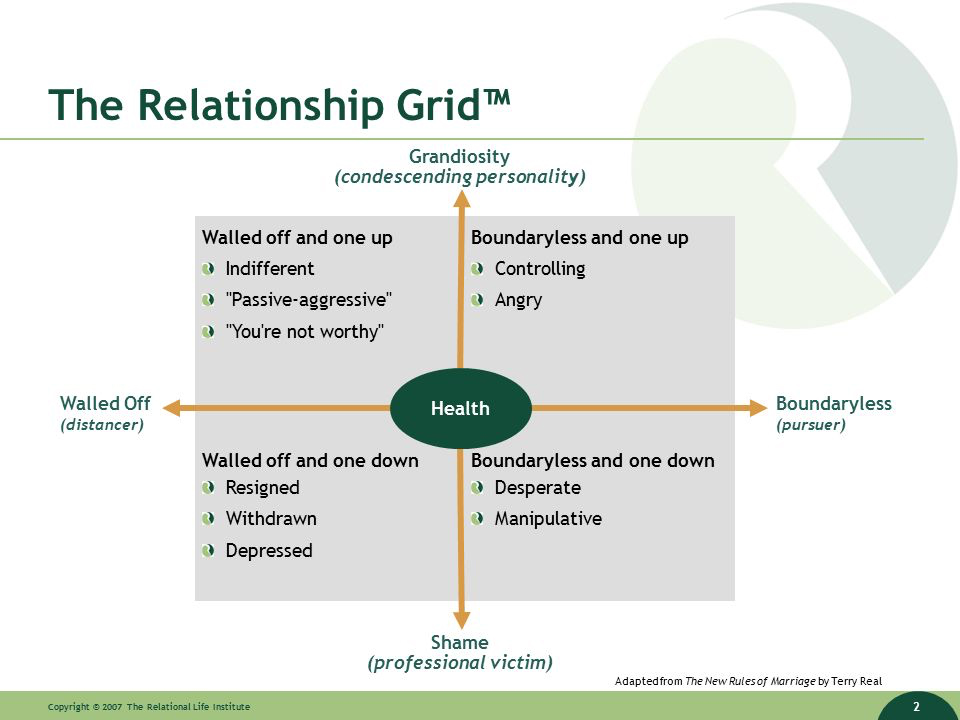
This is a must-take quiz. It will place you in a quadrant. Here you will see if you either “one-up,” internally or externally criticizing others via grandiosity, or you “one-down,” shaming yourself. And, then you assessed as either “boundary less,” taking others’ views very much to heart, or “walled-off,” distancing yourself from others. You will then get a general description of the behavior and emotions associated with this, how it affects you in your relationships, and how you may have developed in this way. Take the quiz.
Books
Love and Relationships
- Fierce Intimacy: Standing Up to One Another with Love by Terry Real. This work is an introduction to this man’s no-nonsense approach to couple’s work. He addresses patriarchy, grandiosity, shame, and self-esteem in partnerships. He helps to identity possible ways we end up using what he calls “losing strategies” in relationships. Excellent.
- Mating in Captivity by Esther Perel. This seminal work addresses some of the fears that face couples as they deal withe the land-mined world of intimacy and sex. She is particularly focused on how women negotiate being sexual with being domestic.
- The New Rules of Marriage. Terry Real uses a sociological approach to understanding what both women and men might do differently to develop a satisfying and intimate relationship. He is a radical thinker and therapist with regard to his recognition of patriarchy and how it has oppressed women and robbed men.
Articles
- 10 Commandments of Time Outs in a Relationship. This is Terry Real’s notion that we should not, interact with our partners when we are in, what he calls, the adaptive child (a response to the wounded child). We need to bring in a functional adult. In order to do this, you need to calm the limbic system, and these are some ways to do this.
Videos
- The Power of Taking Time Outs in Your Relationship by Terry Real. This video is a quick look at how useful it is to begin to recognize when your limbic system has kicked in when you are in a conflict with your partner. Terry Real helps you to become aware of your “whoosh,” that physical feeling that overcomes you when you feel attacked or criticized or something like this by your partner. Most of us get defensive when this happens, but not everyone. Some of us feel shame and withdraw. The point is to become aware of this and tell your partner you need a timeout to calm the limbic system. He suggests you agree about how this will go well before conflict arises. Further, you can read his article, The Ten Commandments of Time Outs in a Relationship, noted above.
Videos
Ways to calm the limbic system: These four methods to calm the limbic system can be used alone or together, although together is really fun. We need to calm a limbic system that can sometimes be turned on all the time. This might be from childhood (a formative trauma: someone scared you; you were not sure what was going to happen, etc), or from a more recent trauma that has gone unprocessed and is making you reactive even when there is no danger.
- Breathing
First, you can engage Wim Hof’s (the Ice Man) breathing and holding strategy. Follow his video. - Yoga and Meditation
Then try using Yoga with Adriene (start with her 2015 series) and see if you can get into this habit. - Cold Shower
Then try a one to two minute cold shower, which forces all the blood in your body to move through the liver at least once. This is Wim Hof again. - EFT (Emotional Freedom Technique) Tapping
This is a growing and more widely utilized technique you can use any time.
Supplements
- GABA Gamma–Aminobutyric. Humans produce this enzyme naturally, and it calms the limbic system. For some of us, either we don’t make enough, or the limbic system is turned on too high, or too long, or both, so we need extra. You should feel the absence of anxiety when this works. It’s very subtle. Most people can handle 200-500 mg twice daily. Some feel weird when they take it, a tingly feeling, which generally goes away after a few minutes. Still, reduce the amount if you don’t feel better. And stop if reduction doesn’t work.
- N-Acetyl Cysteine (NAC). This is a form of an amino acid that has tons of research behind it. It seems to be effective depression, anxiety, and OCD. It also has good promise bi-polar condition, and Parkinson’s disease. You can take a lot of it, up to 1800 mg twice daily. The idea is the gut-brain connection is in action here. DO NOT TAKE THIS AFTER DRINKING ALCOHOL. You can take it roughly 30 minutes before drinking alcohol which will reduce your impulse to drink. (Also works for other impulse control issues like gambling.)
- 5-HTP: Again amino acid precursor, which helps with serotonin levels. Works for some of us.
- St. John’s Wort. Great for some with mild depression. Works about 60% of the time.
Films
- Run, Lola, Run: this fun (German) film is about how a tiny change in something can alter everything; a very positive take on existentialism (an otherwise somewhat dark philosophical approach to life). Subtitled.
- I Heart Huckabees: I loved this movie. Again with an existentialist theme, but rather “heavy handed,” according to my nephew.
- Defending Your Life: What are we doing here, on Earth? How knows. But according this delightful film, we are “overcoming fear.” If we do this, we get to “move on in the universe.” Seriously hilarious.
- What the Bleep Do We Know: Quantum physics meets the Tarot. This charming look at the power of things we can’t see or hear may transform what we believe is possible.